
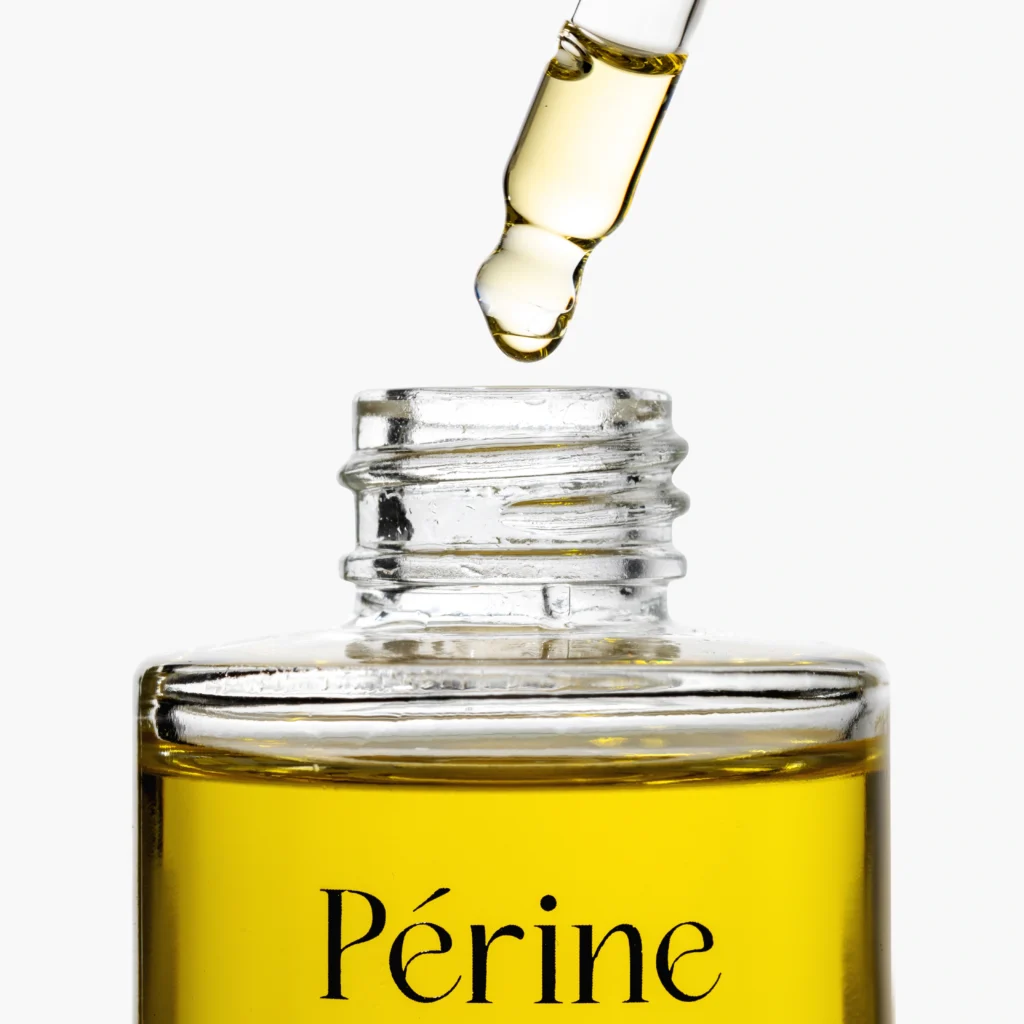
The biggest deterrent to shopping online is the inability to be able to feel or touch an object. This is what macro photography addresses. It taps into a common user behavior of zooming in on specific product features to get a closer, more realistic sense of what they’re buying. This varies across different e-commerce streams. For instance, a fashion brand would focus on highlighting the fabric’s texture, while an electronics brand would focus on highlighting the actuators and functions.
Executing this requires specialized skills and high-grade equipment along with a dedicated space. Said this, let’s now give you a look into everything that goes behind this photography style and how to combine strategies in an optimal way.
Macro Photography Key Insights OverviewMacro product photography bridges the sensory gap in online shopping by enabling high-magnification visual inspection of texture, material quality, and craftsmanship. It relies on specialized gear, controlled lighting, and precision techniques like focus stacking, tilt adjustments, and cross-polarization. Buyers prioritize sharp, accurate details and flaw-free presentation. While execution is technically demanding, professionally produced macro visuals significantly enhance product credibility, consistency, and conversion performance across diverse e-commerce categories. |
Understanding Macro Photography in Product Photography?
Macro product photography is a specialized technique that captures extreme close-up images of a product. It is typically at high magnification (often 1:1 or greater). This helps to reveal fine details not visible to the naked eye. It’s widely used to showcase textures, precision, and build quality, like the stitching on a leather bag, the engravings on jewelry, or the grain of a cosmetic product, helping buyers closely inspect what they’re purchasing.
Essential Gear for Macro Product Photography
- Macro Lens (True 1:1 magnification): A dedicated macro lens is non-negotiable. Look for 90mm–105mm focal length (like a 100mm f/2.8 macro) for sharpness, minimal distortion, and comfortable working distance.
- Camera with High Resolution Sensor: A DSLR or mirrorless camera with at least 20MP+ helps capture ultra-fine details and allows cropping without losing quality.
- Tripod (Sturdy + Adjustable): Macro shots amplify even tiny shakes. Use a solid tripod with a ball head or geared head for precise framing.
- Macro Focusing Rail: This lets you move the camera in tiny increments, critical for focus stacking and achieving sharpness across the subject.
- External Lighting (Continuous or Flash): Use LED panels or off-camera flash with adjustable intensity. Built-in lights won’t cut it for detail work.
- Diffusers & Light Modifiers: Softboxes, diffusion sheets, or light tents help eliminate harsh shadows and evenly light tiny textures.
- Reflectors (Small-scale): Mini reflectors or even white cards bounce light into shadows and highlight fine details.
- Focus Stacking Software: These are essential to combine multiple shots for full-depth sharpness.
| Quick tip: For most e-commerce brands, investing in specialized macro equipment can be capital-intensive, and more importantly, using it effectively requires technical expertise, which is why partnering with a professional studio or renting a fully equipped setup is often a more practical and results-driven approach. |
What Details Matter Most to Online Buyers?
In macro product photography, online buyers focus on hyper-specific visual cues that signal quality and authenticity.
- Texture clarity is key; fabric weaves, leather grain, or surface finish should appear crisp and true-to-life.
- Edge definition and stitching precision help assess craftsmanship, especially in fashion or accessories.
- Buyers also notice material consistency, no bubbles in glass, and no uneven coating on metals.
- Color accuracy at close range matters, as slight shifts can misrepresent the product.
- Fine details like logos, engravings, or product labels must be sharp and legible.
Even micro imperfections (dust, scratches) can impact trust, so flawless presentation is critical. To better understand the composition of various product images, check out our blog on the architecture of e-commerce product photography!
Techniques to Improve Your Macro Product Photography
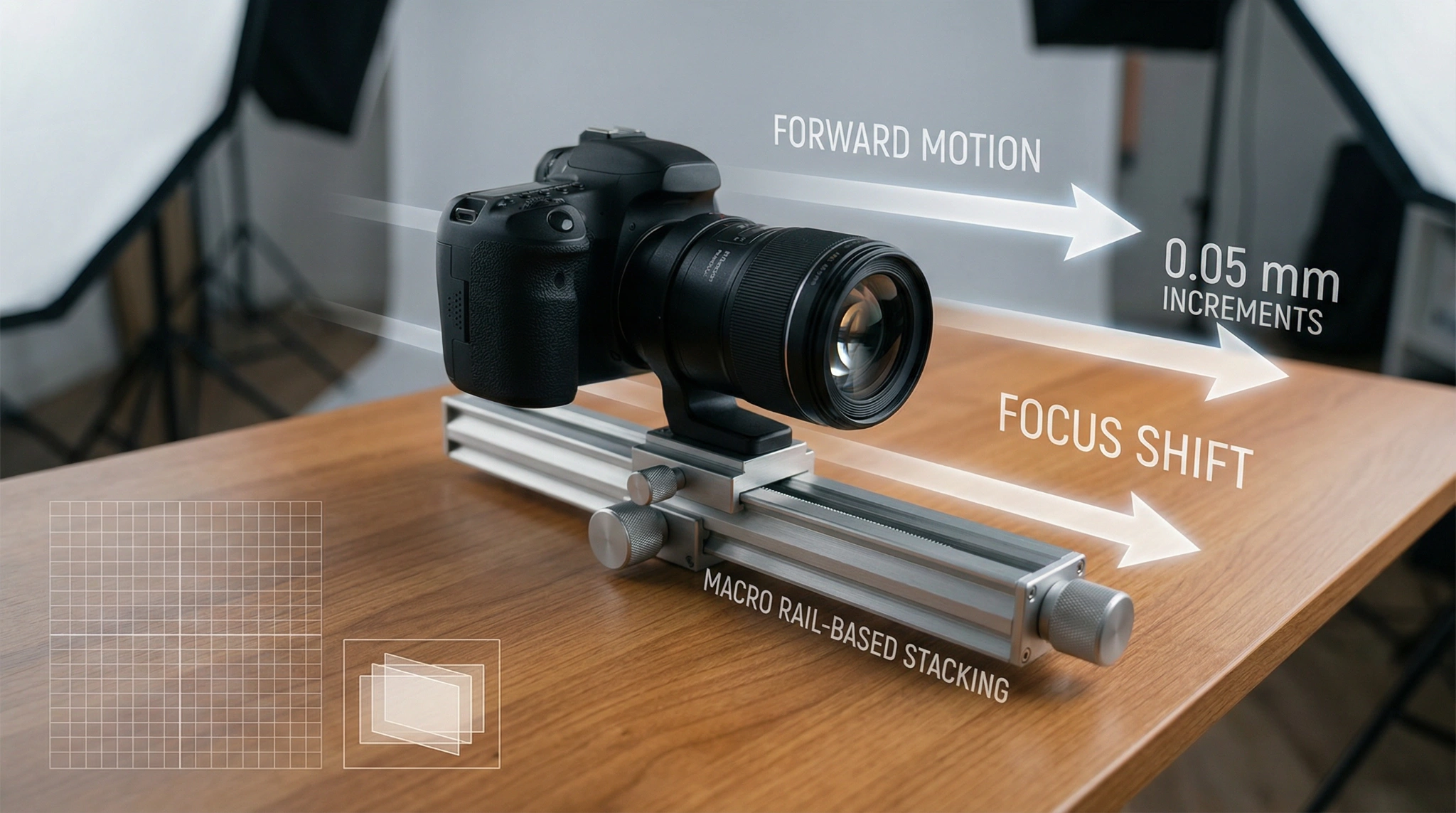
True Rail‑Based Focus Stacking (Not Lens Refocus)
Instead of turning the focus ring, mount the camera on a macro focusing rail and slide the entire camera forward in tiny increments. This keeps magnification, perspective, and framing constant, so stacking software has less work aligning frames and produces cleaner edges with fewer halos and ghosting artifacts.
Key specifics: At 1:1 to 3:1 magnification, step sizes are typically in the 0.05–0.2 mm range; you lock focus at the lens’s sharpest aperture (often around f/5.6–f/8 on high‑res sensors) and only move the rail.
Camera‑Driven Focus Bracketing with Flash Pauses
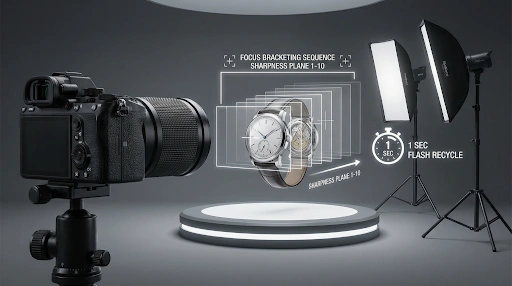
On macro photography bodies that support it, use automatic focus bracketing so the camera shifts focus internally and fires a programmed number of frames. You set three things: starting focus point, step size (smaller at higher magnifications because the depth of field per frame is extremely thin), and number of shots. If you use flash, add a per‑frame delay (e.g., 0.5–1 s) so the flash can recycle fully; this avoids exposure variation across the stack and gives more consistent stacking results.
Using Tilt (Scheimpflug) for Depth
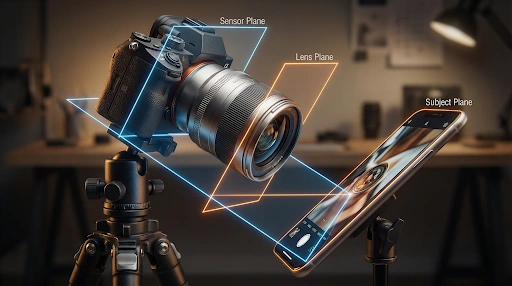
A tilt‑shift lens or bellows movement lets you rotate the lens plane relative to the sensor, which rotates the focus plane (Scheimpflug principle). By tilting the lens so the plane of focus aligns with a product surface (e.g., a watch face or phone screen), you can get that entire plane sharp at a relatively wide aperture, reducing or even eliminating stacking.
Typical workflow: roughly align product and camera, apply a small tilt, refocus until the whole front plane “snaps” into focus, then fine‑tune tilt and distance to balance sharpness between that plane and other features.
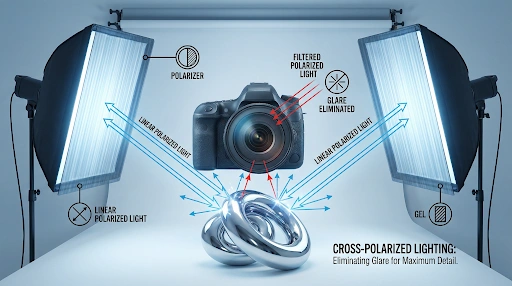
Cross‑Polarized Lighting
Cross‑polarization removes harsh specular reflections from glossy or metallic surfaces while preserving shape and texture. You place linear polarizing film over each light so emitted light is polarized, and a circular polarizer on the lens, then rotate the lens polarizer until reflections dim or disappear.
- For pack shots, you often go for full cancellation to reveal printed detail and surface texture
- For lifestyle product shots, you back off slightly to maintain controlled highlights and a natural sheen.
Tethered Capture and Stacking Workflow
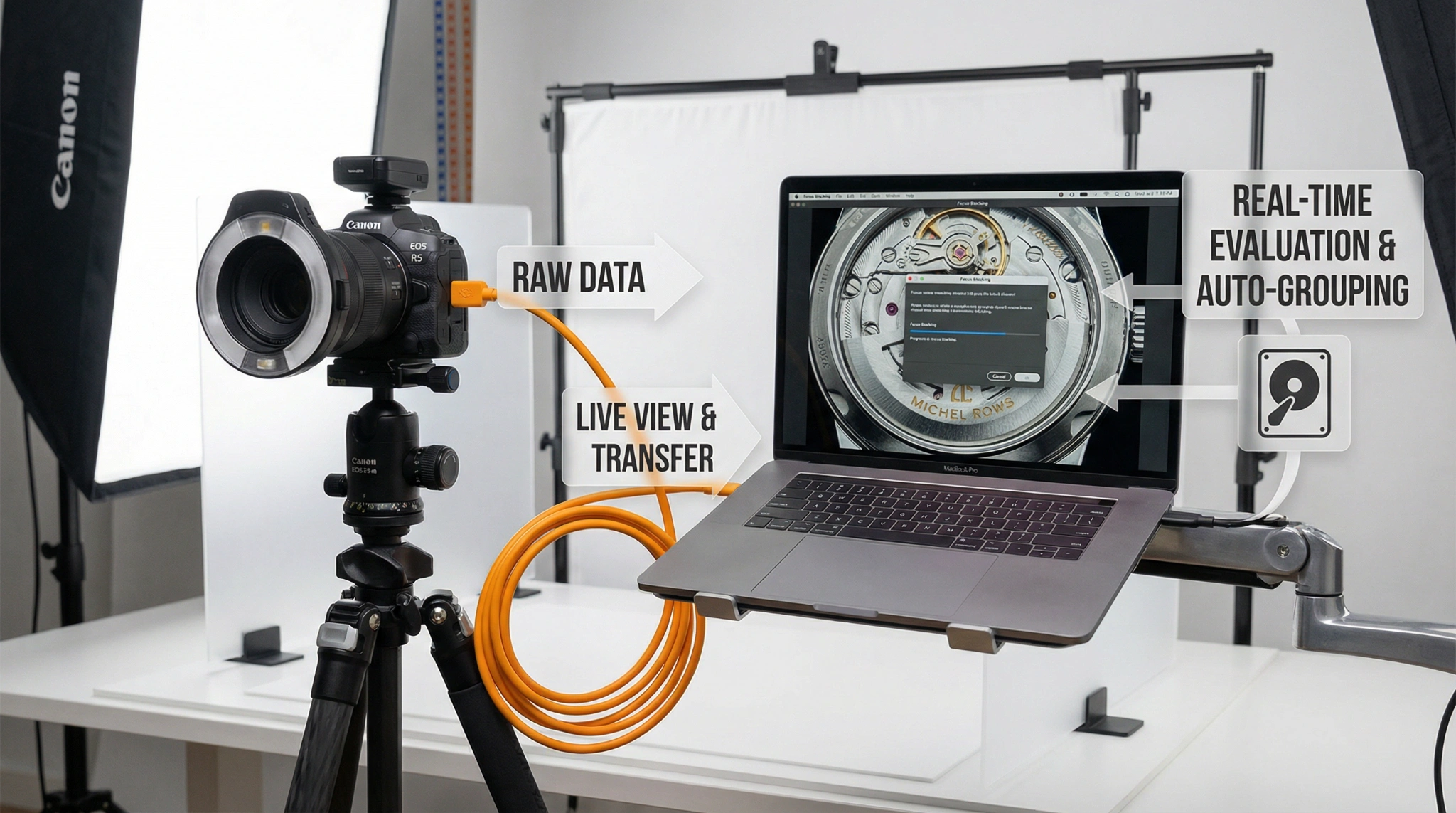
Shooting tethered (camera connected to a computer) lets you evaluate focus steps, micro‑contrast, dust, and defects at 100% as you shoot. Professional photographers set the software to auto‑import each frame, display them full‑screen, and group stacks as they come in; from there, sequences can be sent directly to stacking software, then returned for retouching. This also standardizes framing and exposure across many similar products, because you can use on‑screen guides, copy settings, and reuse retouching layers on multiple stacked files.
Conclusion
Executing macro product photography at a level that truly drives conversions requires a deep understanding of how visuals influence buyer behavior. This is where working with experts becomes essential. And for assistance, you can always reach out to Elena Vels Studio. We are a professional product photography studio known for creating clean, high-impact visuals tailored for e-commerce and commercial brands. Our work focuses on capturing true-to-life textures and brand-aligned imagery that not only looks premium but is designed to convert.
So, get in touch today to create high-impact macro visuals that don’t just look good, but actually drive results.
FAQs
What magnification ratio is ideal for e-commerce macro shots?
A 1:1 ratio is standard, but 1.5:1 to 3:1 is often used for ultra-detailed product sections like engravings or micro-components in premium listings.
What file format is best for macro product photography editing?
RAW format is preferred as it retains maximum image data, allowing precise adjustments in exposure, white balance, and detail recovery during post-processing.
How do professionals handle heat buildup during long macro shoots?
They use LED lights with low heat output, take shooting intervals, and maintain airflow to prevent product damage, especially for cosmetics or sensitive materials.
What preparation is required before sending products for a shoot?
Products should be clean, defect-free, and retail-ready. We also discuss pre-shoot guidelines to ensure optimal results.
How can macro photography improve my sales performance?
High-detail images build trust, reduce uncertainty, and help customers make confident decisions—often leading to higher conversions and fewer returns.